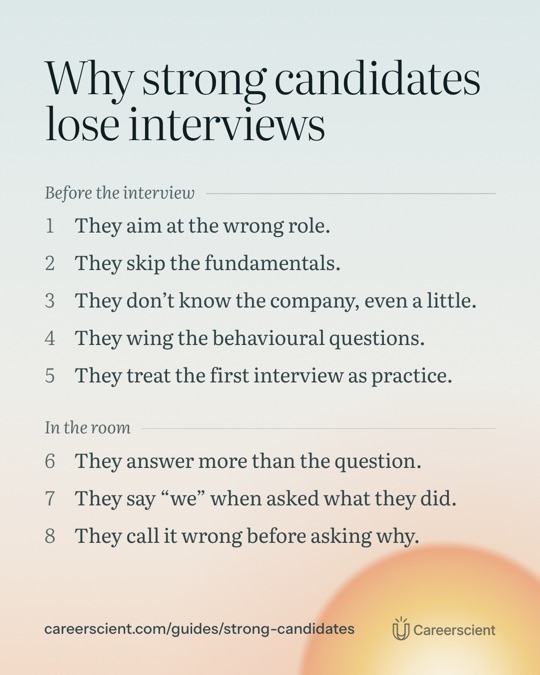
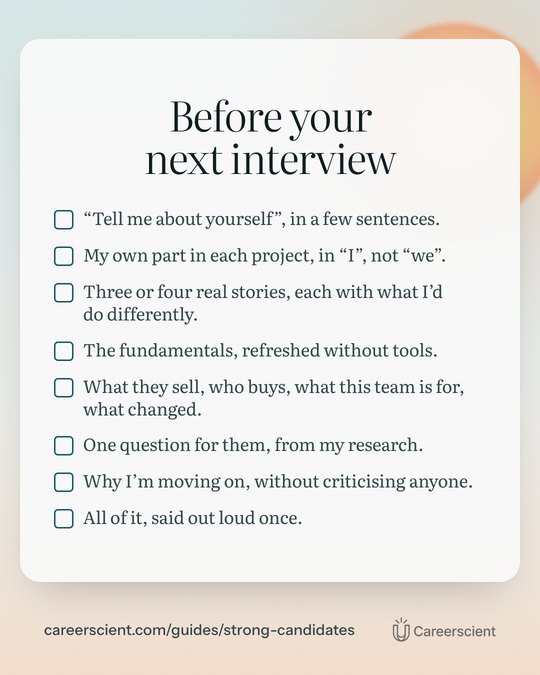
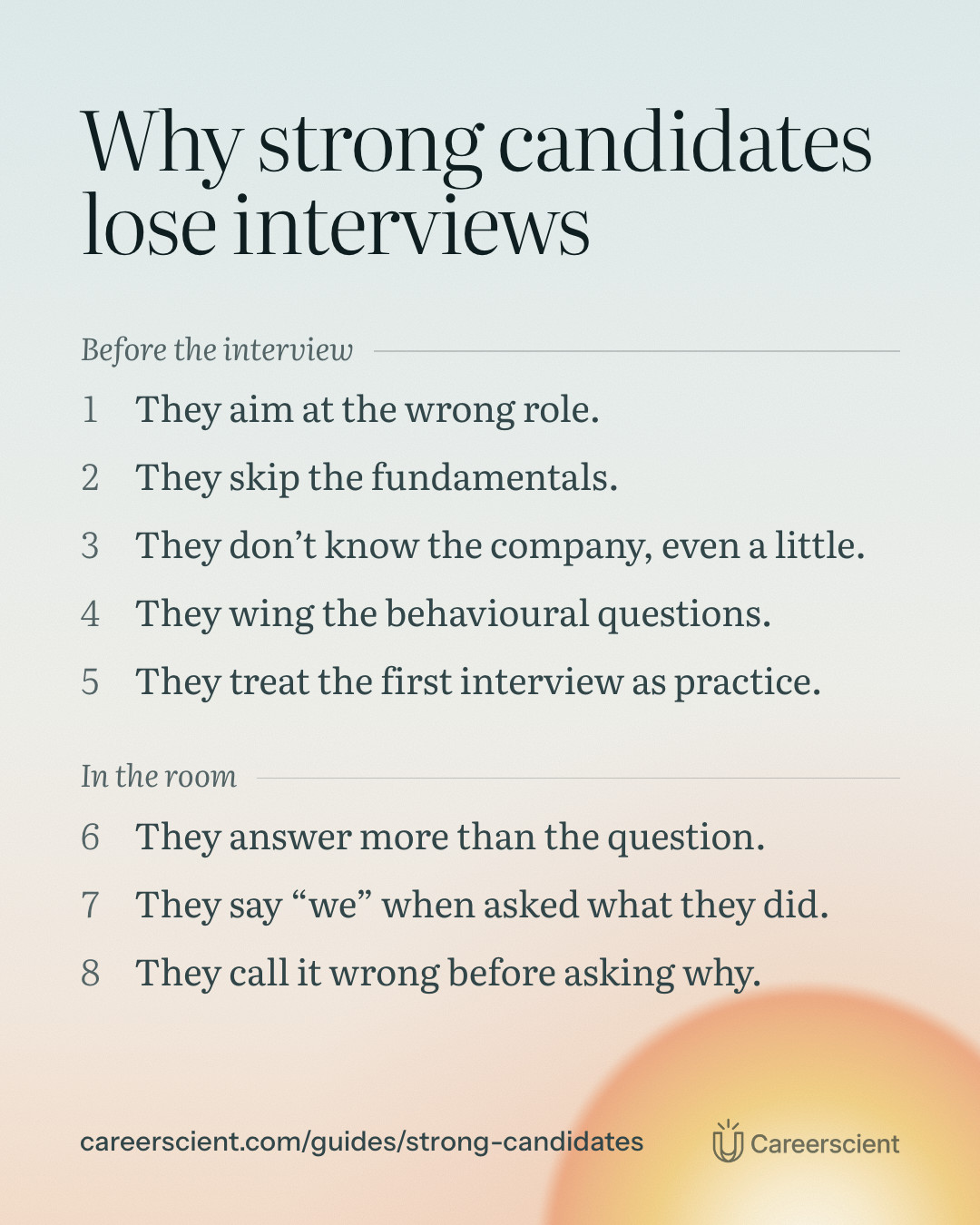
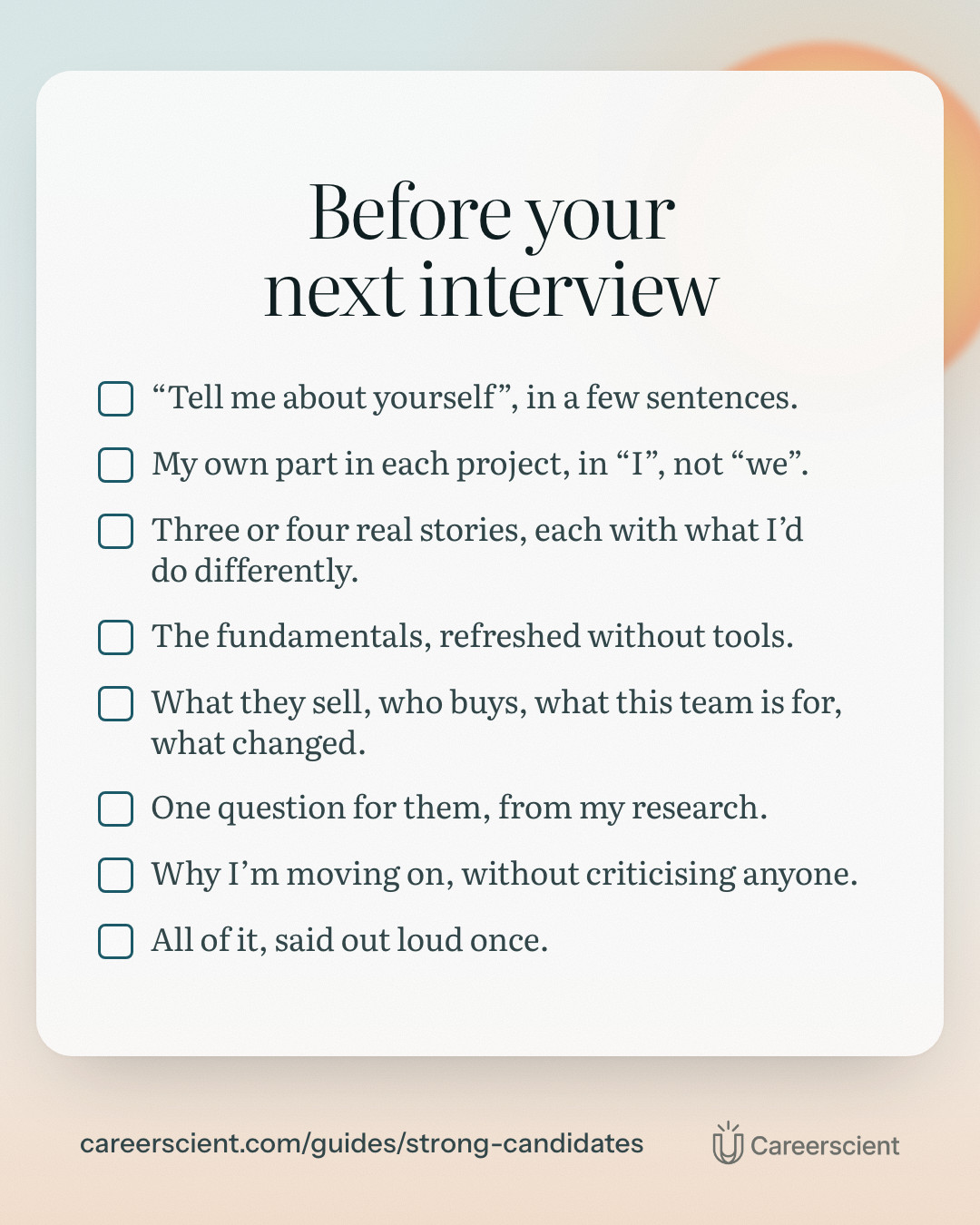
Five of the eight points are settled before you walk in
The guide at a glance
Before the interview
1. Pick the right role, up or down
Many people aim at the wrong role, then decide their career is over. A staff engineer applies for manager roles, a senior account executive for head-of-sales roles, a manager for director roles. The rejections pile up, and the conclusion becomes “something is wrong with me.” Often the target was wrong, not the person.
A few things we’ve seen hold true:
Moving up is harder than it looks. Growing internally takes time, and jumping a level when you switch companies is rarer still. Outside a boom like 2021–22, most moves are sideways. Expect better pay, not a bigger title.
Changing track on the way in is rare. Few companies hire someone from outside as a first-time manager.
Stepping down isn’t easy either. Applying for a level you’ve already done means proving you’re hands-on again, and those interviews (coding, system design, a modelling test, a mock sales call, whatever your field uses) are just as demanding. It can bruise the ego to struggle with something you used to do every day. Don’t let that turn into regret. Prepare for it like any other interview.
2. Know your fundamentals cold, then show judgement
If your career started in the last two or three years, you learned the job alongside AI. Most of the people interviewing you didn’t. They learned the fundamentals by hand, and they still know them cold.
That shapes how they judge you. Miss a fundamental and the thought in the room is “doesn’t even know this”, and the role can go to someone with five or six years who started before AI.
What counts as a fundamental depends on your field. A few examples of what you should be able to explain without help:
Software
why a query or a page is slow, and what happens when a service it depends on fails.
Data and AI
how a join can quietly duplicate or drop rows, and how you’d tell a real effect from noise.
Sales
how you qualify a deal, and how your pipeline turns into a forecast.
Marketing and design
who the customer is, and how a change would show up in the funnel.
Finance and accounting
how the three statements connect, and why accruals exist.
Know yours. Then think like an architect, not a memoriser. If in real work you’d look something up, delegate it or check the documentation, say so. “I’d confirm the exact syntax in the docs” or “I’d check the treatment against the accounting standard” is a professional answer. If they still want it from memory, give it your best attempt and say which part you’d check. Either way, you’ve shown them how you actually work.
What our data says: in the job postings we track, 5.5% of roles that aren’t AI jobs now ask for AI skills, rising to 8–15% in software engineering, product, design and solutions architecture (Careerscient postings data, October 2026 ). Employers want both: the fundamentals, and the judgement to use AI well.
How we measure this
Counted on the job postings Careerscient reads from employers’ hiring pages: 94,112 active US postings, first read by us 19–27 Oct 2026. A posting counts as asking for AI skills when its description asks for experience, familiarity, fluency or similar with AI, generative AI, LLMs, ChatGPT, Copilot, Claude, Gemini or prompting. Postings with an AI or ML term in the job title are left out, and asks worded another way are missed, so the share is a floor. The share moves as new postings arrive; this one was read in October 2026.
3. Know the company, just enough
Understand the company and the team before you go in. Not deeply; nobody expects you to know their strategy better than they do. Just enough to know what they sell, who buys it, what this team is for and what has changed recently.
Then turn what you found into a question for them. Most interviews end with “What questions do you have for us?”, and “None, you’ve covered everything” wastes the last good minute. For example, “I saw you started selling to larger customers this year. How has that changed what this team works on?” One question like that shows you cared enough to look.
4. Prepare your stories: behavioural questions sink more people than technical ones
It surprises people, but we’ve seen many pass the technical or case rounds and fail the behavioural one. “Tell us about a conflict with your manager.” “A difficult situation you handled.” “A complex project.” People arrive unprepared, reach for an example on the spot, pause, ramble, and come across as unconvincing, sometimes as not genuine.
Prepare three or four real stories before you go: a conflict, a mistake, a hard decision, a project that stretched you. For each, know what happened, what you did, and what you’d do differently. Don’t skip the last part. It’s how an interviewer tells that you learned something rather than just got through it.
One well-prepared story can answer several questions, so you don’t need a dozen. In the conflict story, describe what you disagreed about, not what was wrong with the other person. Then tell it the way you’d tell a colleague, in plain words, with the real details left in.
5. Make your first interview your best one
A pattern we see all the time: someone loses four or five interviews, then cracks the sixth. The sixth wasn’t easier. They were finally prepared.
Why not the first? Most people know, walking out, that they could have prepared more. Deal with that feeling before the interview, not after. Practise out loud, not just in your head. Say your stories to a friend who will interrupt you, or record yourself once and listen back. Rehearse the questions you’re dreading most.
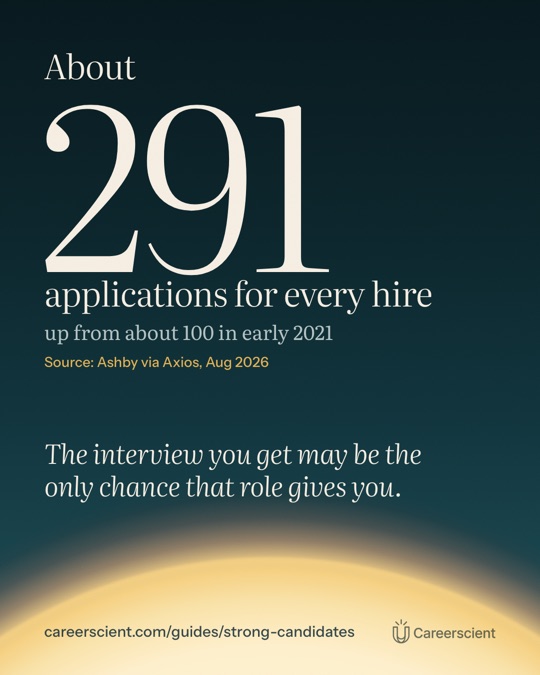
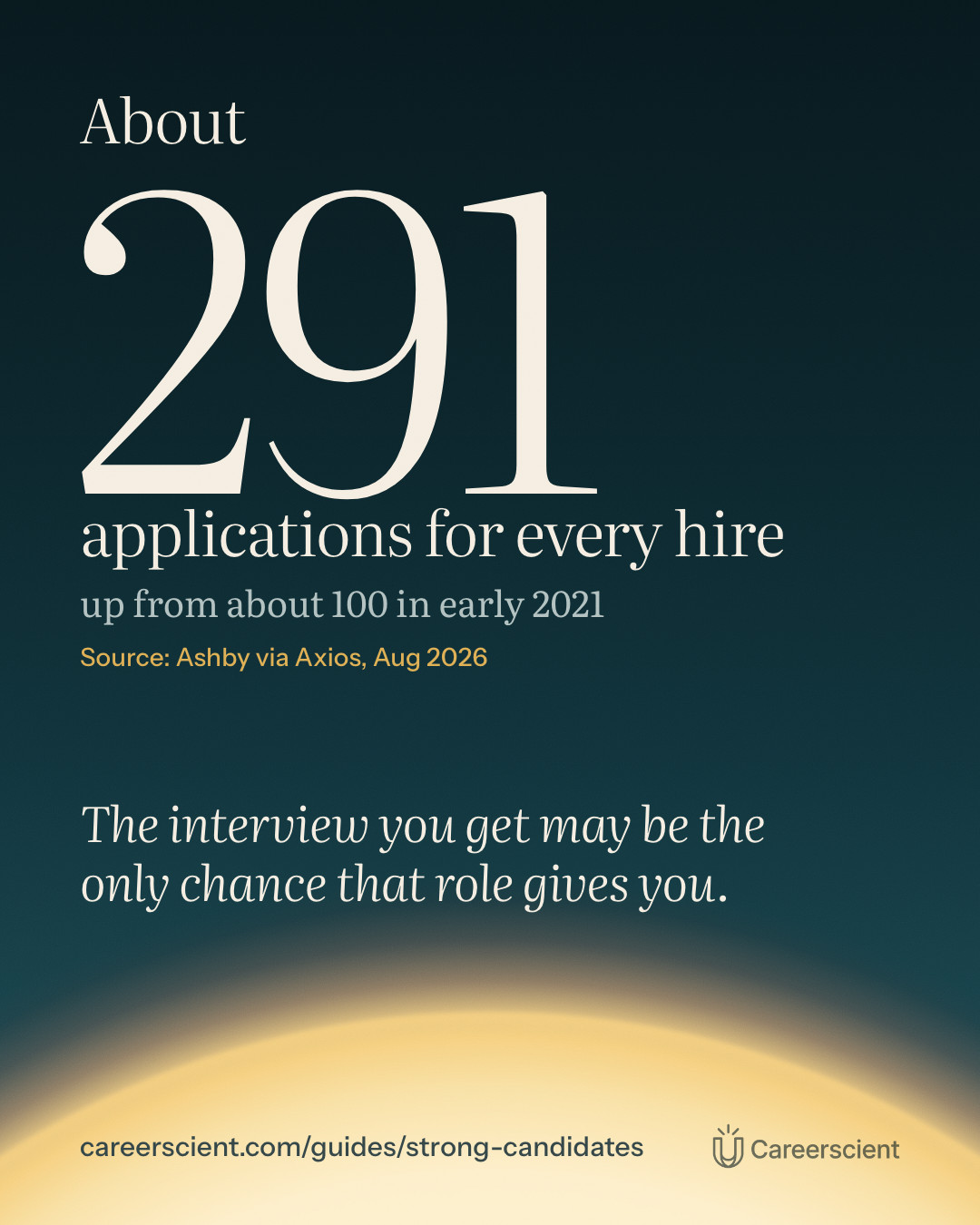
Interviews are also harder to get than they were. With AI, one role can draw hundreds of applications, so the interview in front of you may be the only chance that role ever gives you. Don’t spend it as practice.
What the data says:
recruiters now handle about 291 applications for every hire, up from about 100 in early 2021
Source: Axios, citing Ashby, 21 Aug 2026
How this number is measured
Ashby makes hiring software. The figure comes from hiring on its platform, reported by Axios on 21 August 2026, so it describes the companies that use Ashby, not every employer. Ashby’s own release of 7 May 2026 puts the average above 300 applications per hire, three times the 2021 level. We show the lower figure.
In the room
6. Answer the question, then stop
Of all eight, this is the one we see most. Asked one thing, many people answer everything they know, hoping something lands. To the person across the table, it sounds like you didn’t hear the question. After a few answers like that, it starts to irritate.
It often begins with the first question. “Tell me about yourself” isn’t a request for your whole career. Give the short version that leads to this role, and stop there.
The same fix works for every answer. Put the answer in your first sentence, add the one or two details that support it, then stop. If they want more, they’ll ask.
For example, asked how you shortened the month-end close, a rambling answer starts with the history of the finance team. A clear one starts with “We moved reconciliations from monthly to daily, and I wrote the checklist that made it stick.”
When you don’t know, say so plainly, and say how you’d find out: “I haven’t used that platform. I’ve done the same work on another one, and I’d start by learning where they differ.” Honesty doesn’t guarantee the job. Rambling almost guarantees you won’t get it, because it leaves no positive impression at all.
7. “We built it” versus “I did”
In an interview, what your team built is background. What they’re hiring is you: what you did, and whether it matches the role.
Many people describe the team’s work as their own, sometimes on purpose, often without noticing. Some do it because they haven’t done the thing being asked about, and describing the team feels safer than saying so. Either way, one or two follow-up questions expose it. “What was your part?” “What would have gone differently without you?”
Before any interview, work out your part in each project you plan to mention: the decision you made, the problem you solved, what changed because of you. If you’re early in your career, do the same for an internship or a group project. Doing this also shows you your gaps, and the time to find those is while you’re still in the job, not in the interview chair.
For example,
“We relaunched the pricing page”
“I ran the test that showed the old page was losing trial sign-ups, and I made the case for changing it”
Then match your story to the role. If you say you’re an architect, do your answers sound like an architect’s? If you’re going for a sales leadership role, do they sound like someone who helped others close, or only someone who closed? With AI doing more of the routine work, interviewers care less about what got produced and more about what you decided.
8. Ask why before you call it wrong
Sometimes you’ll see, in the interview, that a team does something a way you wouldn’t. It might be a system design, a pricing model, a sales process or a month-end routine. If they ask how you’d approach it, tell them, with your reasoning and a sense of what you’d do first and when.
What you should never say is “This is wrong. I’d change it on day one.” Every system carries history. Decisions were made under deadlines, budgets, people and market pressures you can’t see from outside. Getting to real revenue at all is rare, and running a business at 20 people, then 500, then 10,000 adds layers that seldom look tidy from where you’re sitting.
So don’t belittle what they built. Ask why it is the way it is, with something as simple as “What led to it being set up this way?” You’ll learn more, and they’ll see someone they can work with.
The same goes for “Why are you leaving?” Don’t criticise your current employer or manager, even if they deserve it. Talk about what you’re moving towards, such as the work, the scope or the kind of team you want to join. Hiring teams hear how you talk about your last company as a preview of how you’ll talk about theirs.
After the interview: when it doesn’t go your way
Much of a job search isn’t yours to control. The timing, the budget, an internal candidate or a reorganisation can decide it before you walk in. When a rejection comes, don’t read it as a judgement on you. Often it’s a market with too many applications and too few signals.
There’s a quick way to tell what to work on.
If you’re getting interviews but no offers, look at how you interview.
If you’re getting no interviews at all, look first at what you’re aiming for.
What is yours is how ready you are, how honestly you answer and how well you know your own work. Keep building your skills and tools while you’re employed, not the week before an interview. Treat readiness as a habit, not an event.
Careerscient keeps a private record of what you did at work, in your own words, so your part of every story is ready before the interview.
careerscient.com